What Is a Cook-Off? A Plain-English Definition
A cook-off is a cooking competition where everyone makes the same dish and the best wins. How it differs from a potluck, and which spelling to use.
A cook-off is a friendly cooking competition where multiple people prepare the same type of dish and the best one wins. Tasters or judges score each entry on criteria like flavor, presentation, and creativity, and a winner is announced based on the highest score.
Cook-offs are everywhere - offices, churches, schools, neighborhood block parties, charity fundraisers, food festivals, and sanctioned competitive circuits. The format is simple, the bar to entry is low, and the social energy is hard to beat. If you've never been to one, this guide explains how they work, what makes them different from a potluck, and the most common types you'll encounter.
The Basic Definition
At its core, a cook-off has four ingredients:
- A category. Everyone makes the same type of dish - chili, BBQ ribs, brownies, guacamole, mac and cheese.
- Multiple contestants. Usually 6-12 entries. Fewer feels thin. More causes taster fatigue.
- A scoring method. Judges using a rubric, the crowd distributing votes, or both.
- A winner. The entry with the highest score takes the top prize.
That's it. The rest is variations on these four building blocks.
How a Cook-Off Actually Works
The format is straightforward:
Before the event: An organizer picks a category, sets a date and venue, recruits contestants (typically 8-12), and decides on judging method and prizes. Contestants prep their entries at home.
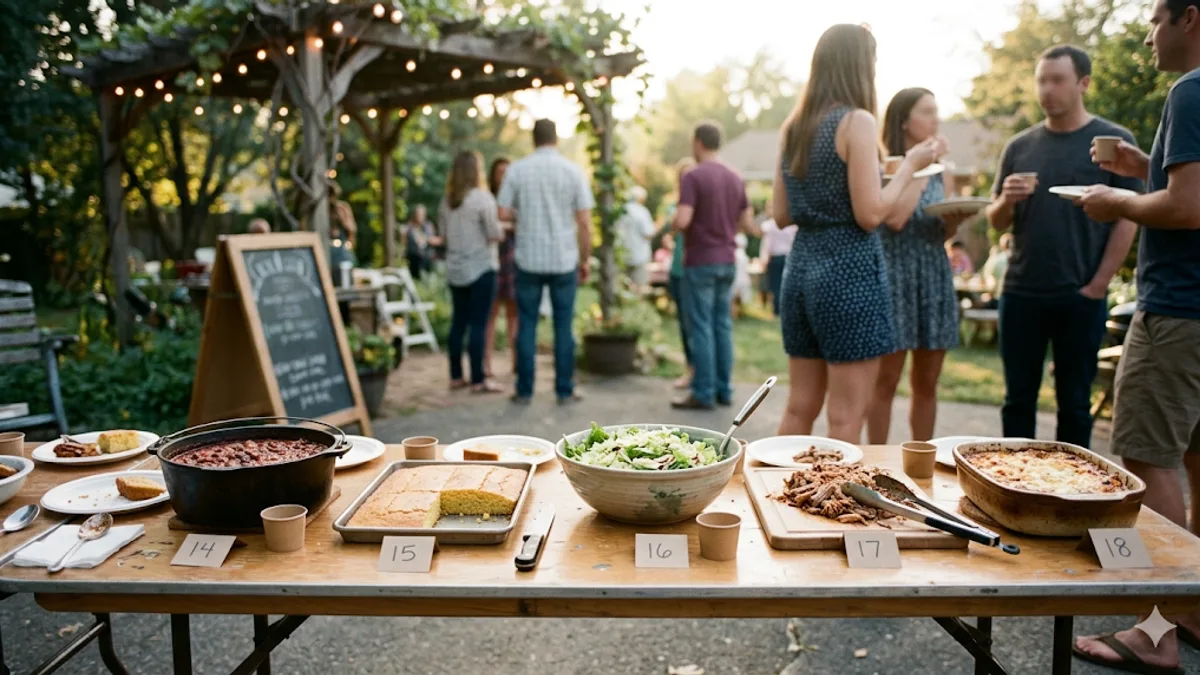
On the day: Contestants bring their dishes and set up at numbered tasting stations. Each entry gets a number, not a name - this is called blind tasting and it prevents bias. Tasters or judges work their way through every entry, scoring each one on a sheet or with a digital voting tool.
After tasting: Scores are collected and tallied. The contestant with the highest score wins. Awards are handed out. Winners get bragging rights, a trophy, gift cards, or a charity donation in their name.
A typical cook-off runs 1-3 hours from doors-open to winners-announced.
Cookoff, Cook-Off, or Cook Off? Which Spelling Is Right
This trips up more people than it should, usually right when they're about to print an invitation.
| Spelling | What it is | Use it for |
|---|---|---|
| cook-off | The dictionary spelling, hyphenated | Anything written down - invites, flyers, programs, an email to the office |
| cookoff | A very common informal variant, closed up | Casual writing, brand names, event names, hashtags |
| cook off | Two words is the verb phrase - "cook off the alcohol" | Not the name of an event |
The short version: write "cook-off" and you're never wrong. "Cookoff" is widely used and nobody will blink at it - it's the spelling in plenty of event names, including ours. "Cook off" as two loose words is the one to avoid, because it reads as an action rather than a thing.
The same pattern shows up across the family: bake-off, cook-off, and sing-off all take the hyphen; bakeoff and cookoff are the accepted informal closures. Plural is cook-offs, not cook's-offs.
None of this affects how you run the event. Pick a spelling, use it consistently across your flyer and your sign-up sheet, and move on.
What Makes a Cook-Off Different From a Potluck
People sometimes use the words interchangeably, but they're very different events.
| Potluck | Cook-Off | |
|---|---|---|
| Goal | Share food | Compete |
| Variety | Everyone brings something different | Everyone makes the same type of dish |
| Judging | None | Required |
| Winners | None | Yes, with prizes |
| Vibe | Communal meal | Friendly competition |
A potluck is about feeding a crowd with no rules. A cook-off is about figuring out whose chili is best. Both are great events, but they serve different purposes.
The Most Common Types of Cook-Offs
Chili Cook-Offs
By far the most popular format. Chili is cheap to make, travels well, scales to large crowds, and almost everyone has an opinion about what makes good chili. Office events, fundraisers, and neighborhood block parties default to chili more than any other category. There's even a sanctioned competitive circuit (CASI) for serious chili cooks. See our how-to guide for running one, our judging criteria breakdown, and a contestant tactics guide for how to actually win one.
BBQ Cook-Offs and Smokeouts
Outdoor competitions where contestants smoke or grill meat - usually brisket, pulled pork, ribs, and chicken. These are bigger productions: contestants need smokers, prep tables, and hours of cook time. Sanctioned BBQ circuits (KCBS, MBN) have professional competitors. Backyard versions are more casual but still fun. See our BBQ cook-off guide.
Bake-Offs
Cookies, pies, brownies, breads, cupcakes, scones. Bake-offs work great for school fundraisers, church events, and family gatherings because the entries are easy to transport, easy to portion, and don't need to be served hot. See our bake-off guide.
Potluck Competitions
A hybrid where everyone brings something different (like a potluck) but entries are still judged and a winner is named. Best for events where you want variety but also want to recognize standout cooks. See our potluck competition guide.
Specialty Cook-Offs
Less common but increasingly popular:
- Guacamole - quick, photogenic, perfect for summer events
- Salsa - same energy as guac, easier to make ahead
- Wings - sauce variations are endless
- Mac and cheese - comfort food, big crowd appeal
- Tacos - usually a "best taco filling" competition
- Burgers - works for backyard cookouts
- Pies - sweet or savory, popular at Thanksgiving and county fairs
Who Hosts Cook-Offs?
Cook-offs happen across every kind of group:
- Workplaces. Office chili cook-offs are a staple of company culture, especially in fall and winter.
- Churches. Bake-offs and chili cook-offs are common fundraisers and community events.
- Schools. PTA fundraisers, fundraiser nights, family cook-offs.
- Charity organizations. Cook-offs are one of the highest-margin fundraiser formats. See our fundraiser guide - most events raise $500-$5,000.
- Neighborhoods. Block parties and HOA events.
- Sanctioned competitive circuits. CASI (chili), KCBS (BBQ), and others run year-round events with professional cooks competing for prize money.
How Cook-Offs Are Scored
There are three main scoring methods:
Favorite voting. Each person picks one entry, and the most votes wins. The fastest format, and the usual one for a People's Choice award.
Points scoring. Each judge gets a fixed pool of points (say, 5) to distribute across all entries. They have to make choices - they can't give everyone full marks. Simple, fast, decisive.
Rubric scoring. Each judge rates each entry on multiple criteria (flavor, heat, texture, appearance, creativity) on a 1-10 scale. Slower but more nuanced. Usually used by panels of 3-5 judges rather than the whole crowd.
Many events use both - a panel of judges does rubric scoring for "Best Overall" and the crowd picks one favorite each for "People's Choice." Read the full breakdown of scoring methods for which to use when.
Why Cook-Offs Work as Events
A few things make cook-offs hard to beat:
- Low overhead. Contestants supply the food. The host covers supplies and prizes. A 50-person event runs $150-$300 total.
- High engagement. People don't just show up and eat - they taste, debate, score, and care about the outcome.
- Easy to repeat. The first event is the hardest. Year two takes half the effort.
- Universal appeal. Anyone who eats can participate. No special skills needed.
If you've thought "I should host one of these," our guides cover everything from setting it up to judging it fairly to picking trophies people actually want.
The Bottom Line
A cook-off is a friendly cooking competition where everyone makes the same type of dish and the best one wins by vote or judge score. The format is simple, the bar to entry is low, and the social energy is unmatched. Whether you're hosting one for the office, running a charity fundraiser, or just curious what your neighbors mean when they say "we're doing a chili cook-off this weekend," now you know what to expect.
Related reading:
Now run your first cook-off
Cookoff handles QR-code voting, results the moment you finalize, and winner badges. No paper ballots, no spreadsheet.
Start your first cookoff