How to Judge a Chili Cook-Off: 5 Criteria Judges Actually Use
A practical guide to judging chili cook-offs fairly. Covers the five criteria that matter, blind tasting protocol, palate management, and how to handle ties.
Judging chili sounds simple until you're actually doing it. Ten entries in, your palate is wrecked, three of them "taste pretty good," and you're trying to remember whether Entry #4 was the smoky one or the sweet one. Without a clear framework, the mildest crowd-pleaser wins every time - not because it's the best chili, but because it offended the fewest people.
A good judging system rewards skill and creativity. It separates the person who slow-cooked a complex Texas red for eight hours from the one who dumped a packet of seasoning into ground beef. Here's how to set one up.
The Five Criteria for Judging Chili
Generic "rate it 1-10" scoring tells you nothing useful. Break it down into five criteria, each scored on the same 1-10 scale and averaged together for an entry's total.
If flavor should count for more than a fifth of the score, give it more weight - Flavor/Taste at 40%, with the other four splitting the remaining 60%, is a common split. Cookoff does the weighted math automatically, so nobody's dividing scores by hand at a folding table. Leave the weights off and every criterion counts equally, which is the default.
1. Flavor and Taste
This is the big one - and it's not just "does it taste good." You're looking for complexity and balance. A great chili has layers. You taste the first hit of spice, then the depth of the chili peppers, then maybe a hint of chocolate or coffee in the background, finished with a touch of acid that brightens the whole thing.
Specific things to evaluate:
- Seasoning balance. Is the salt right? Can you taste cumin, garlic, oregano as distinct contributors, or does it all blur into one note?
- Depth of flavor. A good Texas red should have a rich, almost meaty depth that goes beyond "tomato sauce with beef." White chicken chili should have a creamy complexity, not just "chicken in cream sauce."
- Acidity. Great chili has a subtle brightness - from tomatoes, lime, vinegar, or beer - that keeps it from feeling heavy and flat.
- Sweetness. A touch of sweetness (from onions, roasted peppers, or a deliberate addition like brown sugar) rounds things out. Too much and it tastes like spaghetti sauce.
Score a 9 or 10 here for chili where every spoonful reveals something new. Score a 3-4 for one-dimensional entries that taste like a single ingredient.
2. Heat and Spice
This is where most amateur judges get it wrong. "Hottest" should never win automatically. Heat is a tool, not a goal. A habanero entry that makes your eyes water but has zero flavor underneath should score lower on heat than a moderately spiced entry where the warmth builds gradually and complements every other element.
What good heat looks like:
- Appropriate for the style. A white chicken chili should have a gentle warmth, maybe from green chiles or a hint of cayenne. A competition-style Texas red can (and should) bring more firepower. Judge heat relative to what the cook was trying to do.
- Builds, doesn't ambush. The best chili heat starts low and builds as you eat. If the first bite makes you grab for water, the spice is doing the work instead of the cook.
- Identifiable source. Can you tell whether the heat comes from ancho chiles, chipotle, fresh jalapenos, or habaneros? That specificity signals a cook who chose their peppers deliberately rather than dumping in cayenne powder.
A perfectly balanced heat that makes you want another bite scores higher than a five-alarm entry that makes you want milk.
3. Texture and Consistency
Good chili has a specific viscosity - thick enough to hold its shape on a spoon, thin enough to flow. Not soup, not paste. This is pure technique.
What to evaluate:
- Overall thickness. Does it coat the back of a spoon? Or does it run off like broth? Either extreme is a problem.
- Meat tenderness. Beef should be fork-tender, not chewy. In a well-made chili, the meat has broken down enough to absorb flavor but still has enough structure to provide texture.
- Bean texture (if included). Here's where we touch the great chili debate: beans or no beans. If you're judging, don't penalize either choice - but if beans are present, they should be creamy inside with intact skins, not mushy or chalky. If they're absent, the chili should still have body from other sources.
- Vegetable integration. Onions and peppers should be soft and integrated, not raw chunks floating in sauce.
Score high for chili that clearly had its cook time dialed in. Score low for entries that feel under-cooked (thin and grainy) or over-cooked (homogeneous mush).
4. Aroma
You smell chili before you taste it, and that first impression matters. Good chili announces itself. Lift the lid on a well-made pot and you should get hit with toasted spices, roasted peppers, and slow-cooked richness.
Aroma tells you a lot about technique. Chili that smells like raw garlic or untoasted cumin usually tastes that way too. A deep, complex aroma - where you can pick out individual spices - signals a cook who bloomed their spices in fat before building the pot.
If an entry smells flat or mostly like canned tomatoes, that's information. If it smells like a kitchen that's been simmering all day, that's a good sign.
5. Appearance and Color
Does it look like something you want to eat? Appearance matters more than people think - it's the visual equivalent of aroma, setting expectations before the first bite.
What to look for:
- Color depth. A great red chili has a deep, brick-red to mahogany color that comes from real chili peppers, not food coloring or an ocean of tomato paste. A white chicken chili should be creamy and inviting, not gray.
- Garnish and presentation. A sprinkle of fresh cilantro, a dollop of sour cream, a few sliced jalapenos on top - these signal a cook who cares about the complete experience. No garnish isn't a dealbreaker, but thoughtful presentation earns points.
- Visual texture. Can you see distinct ingredients? Visible chunks of pepper, pieces of meat, and maybe some beans create visual interest. Uniform-color sludge does not.
This criterion rewards cooks who treat chili as a complete dish, not just a pot of brown stuff.
Blind Tasting Protocol
The single biggest thing you can do for fair judging: nobody knows who made what until after scoring is done. Here's the protocol.
Number Every Entry
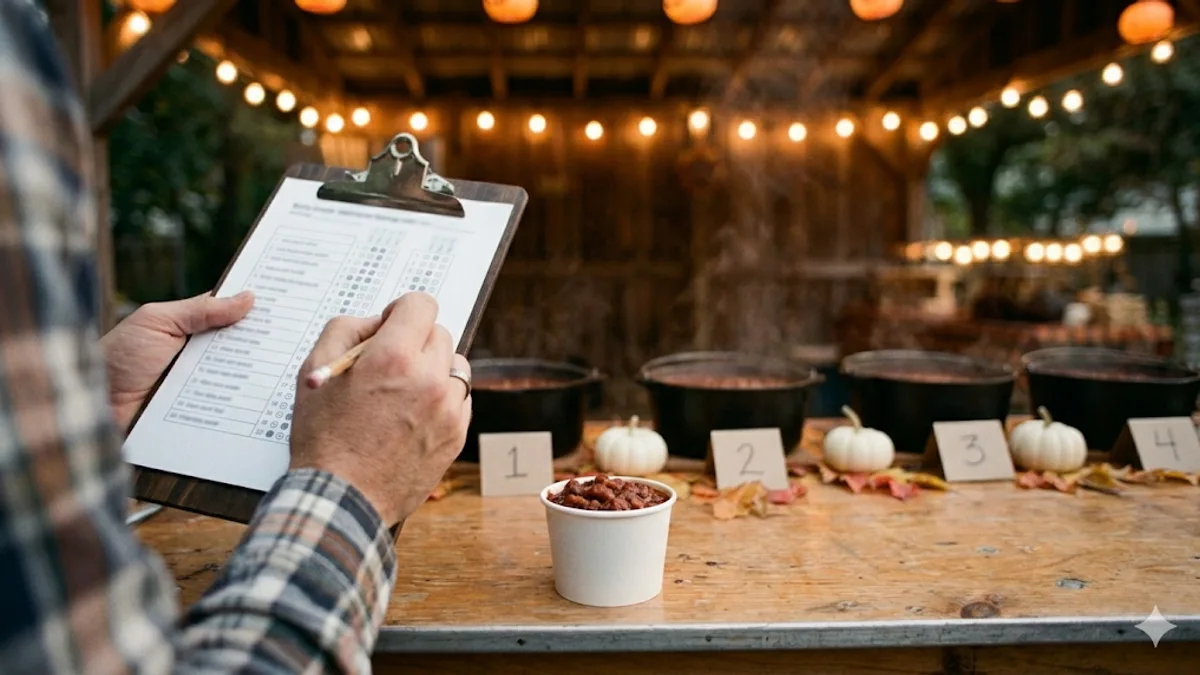
Assign random numbers when cooks drop off their entries. Keep a master key in a sealed envelope (or on the organizer's phone). Nobody sees the key until results are final.
Tasting Order Matters
If you start with a five-alarm habanero entry, everything after it will taste bland by comparison. Two approaches work:
- Mild to hot. If you know the approximate heat levels, arrange them in ascending order. This preserves your palate for the longest.
- Randomized with palate cleansers. If you don't know heat levels in advance, randomize the order but enforce palate cleansing between every entry.
Use Small Portions
Three-ounce cups (the little bathroom-size ones) are ideal. You need enough for two or three spoonfuls - one to get the first impression, one to evaluate depth, and maybe a third to confirm your scores. Larger servings lead to palate fatigue faster and waste food.
Palate Cleansers Between Every Entry
This is non-negotiable. Between each entry, eat or drink something neutral:
- Plain crackers or white bread (best option - absorbs residual heat and flavor)
- Room temperature water (not ice cold, which numbs your palate)
- Plain tortilla chips (work in a pinch)
- Not beer. Despite what every chili cook-off flyer suggests, alcohol dulls your taste buds. Save the beer for after judging.
Score Immediately
Write down your scores for each entry right after tasting it. If you try to score all ten entries from memory after finishing the last one, your scores will be unreliable. The entries you tasted most recently will score higher (recency bias), and the entries in the middle will blur together.
Competition bodies formalize this differently than most people assume - see what the official chili cook-off rules actually say for how CASI and ICS each score an entry, and why the popular five-criteria scorecard matches neither.
A note on dish names: if entries carry a name on the tent card, make sure the name does not identify the cook. "Dave's Firehouse Red" defeats a blind format before the first taste. If contestants ask for help, we keep naming guidance and a list of options.
Panel Judging vs. Crowd Voting
Both work for chili. The right choice depends on how serious your event is.
Panel Judging (3-5 Judges)
A small panel using rubric-based scoring across all five criteria produces the most consistent, technique-respecting results. Each judge scores every entry on every criterion, and the scores get averaged.
Best for: Sanctioned competitions, events with prizes worth more than bragging rights, or any situation where you want results that feel authoritative. A panel can appreciate subtle technique differences that a crowd might miss - the slow-rendered beef fat base, the hand-toasted spice blend, the 12-hour simmer.
The downside: Everyone else just eats without a stake in the outcome.
Crowd Voting
Every taster scores every entry. Simpler criteria work better here - either a points allocation system or a simplified rubric with three criteria instead of five. The crowd tends to reward approachable, crowd-pleasing flavors over raw technique. That's not a flaw; it just means crowd voting measures something different than panel judging.
Best for: office events, neighborhood cookoffs, fundraisers where engagement matters more than precision.
The Hybrid Approach
Run both. A panel picks "Best Overall" using the full five-criteria rubric. The crowd picks "People's Choice" using simple scoring. You get two winners, twice the excitement, and nobody feels left out. The panel winner gets credibility; the People's Choice winner gets popularity. Sometimes they're the same entry. Often they're not, and that's where the interesting conversations happen.
Handling Tricky Situations
Every chili cook-off has at least one of these.
Ties
With rubric scoring, ties happen more often than you'd expect. Average position ranking works better than raw score tiebreakers - instead of comparing total points, compare each entry's rank across individual judges. The entry with more consistent high placements wins.
If you need a simpler approach: break ties using the Flavor/Taste score, since it best reflects overall quality.
The "Too Hot to Judge" Entry
Someone always brings a chili that's more weapon than food. Don't throw out the scores - judge it on all five criteria, not just heat. A brutally hot chili can still score well on flavor complexity, aroma, and appearance. It might score low on "heat appropriateness" (because the heat overwhelms everything else) but high on other dimensions. Let the rubric do its job.
Give judges permission to take extra time with palate cleansers after this entry. Rushing to the next one will tank that entry's scores unfairly.
Self-Voting
Either allow it for everyone or ban it for everyone. Never allow partial exceptions. If cooks can vote, their scores will bias the results. If they can't vote and there are only four tasters, you lose 20% of your data. For small events, letting everyone vote (including cooks) and accepting the slight bias is usually the pragmatic choice. For serious competitions, cooks don't vote.
Category Splits
Should traditional red, white chicken, verde, and creative/wildcard entries all compete against each other? For small events (under 8 entries), keep it one category. Splitting into four categories with two entries each makes every result feel arbitrary. For larger events (12+ entries), separate categories let judges evaluate entries against their peers. A white chicken chili shouldn't have to beat a Texas red on "color depth" - they're playing different games.
Making the Math Easy
Rubric scoring across five criteria with ten entries and five judges means 250 individual scores to collect and average. On paper, that's an hour of math and at least one mistake. (Free score sheet templates here if you want to try the manual route first.)
Digital tools handle the averaging automatically. Cookoff supports rubric scoring with custom criteria and optional per-criterion weights, so you set up the five categories above, give Flavor/Taste more weight if it should count for more, and it does the math the instant you finalize.
The Bottom Line
Fair chili judging comes down to three things: clear criteria that reward technique over timidity, a blind tasting protocol that removes bias, and a scoring system that captures nuance. Get those right and the best chili actually wins - which is the whole point.
Related reading:
- The Complete Chili Cook-Off Guide (2026)
- How to Win a Chili Cook-Off: Recipe, Spices, and 5 Mistakes
- How to Run a Chili Cook-Off at Work (2026 Guide)
- 30+ Cook-Off Trophy & Prize Ideas (Free to $100)
- The Complete Cookoff Judging Guide: Points vs Rubrics
- Cook-Off Score Sheets: Free Templates + Digital Alternative
- How to Run a Bake-Off: Categories, Judging, and Score Sheet
Apply this judging guide in two minutes
Set up your chili cook-off in Cookoff with these judging criteria pre-loaded into the scoring rubric.
Set up chili judging