How to Run an Office Chili Cook-Off: 2026 Guide + Checklist
Plan an office chili cook-off in 2-3 weeks. Break-room logistics, allergen rules that keep HR happy, a $65-100 budget, QR code voting, and a day-of checklist.
A chili cook-off at work is hard to beat as an office event. It's low-cost, high-energy, and almost everyone has a family recipe they're secretly proud of. This guide covers everything you need to host one that people will actually talk about.
Quick answer: To run an office chili cook-off, plan 2-3 weeks ahead, recruit 6-12 contestants, set blind-tasting rules with mandatory allergen labels, budget $65-100 for cups/toppings/prizes, and use QR code voting so results come in instantly. Friday lunch is the best slot; cap voting at 90 minutes.
Want a generic walkthrough? How to run a chili cook-off (full guide) covers every format - office, neighborhood, and fundraiser - with rules, judging, and prize advice. This page drills into the office-specific details.
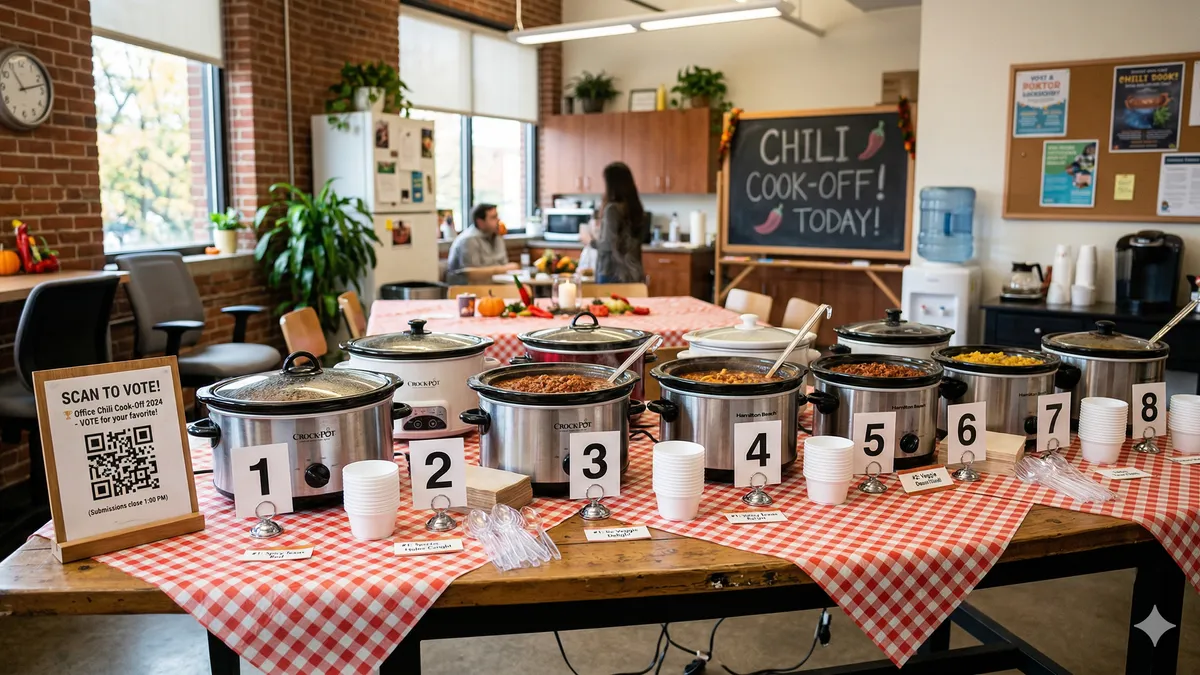
Why Chili Cook-Offs Are Perfect for the Office
There's a reason the office chili cookoff has become a staple. A few things make it uniquely well-suited to the 9-to-5 crowd:
Low barrier to entry. Unlike a bake-off that requires precision or a barbecue that needs specialized equipment, chili is forgiving. You dump things in a pot, let it simmer, and it usually turns out pretty good. Even your coworker who "doesn't cook" can follow a slow cooker recipe.
Easy to transport. A crock pot rides in a car better than a three-tier cake. No assembly required, no last-minute plating. Plug it in and you're done.
Scales to any group size. A single batch of chili feeds 15-20 tasters easily. With 8-10 entries, you can serve an office of 50+ without breaking a sweat.
It's a real conversation starter. People get passionate about their chili. Secret ingredients, regional styles, family traditions - a cooking competition beats a trust fall every time.
Planning Your Cook-Off (2-3 Weeks Before)
Give yourself at least two weeks of lead time.
Pick the Right Date
Friday lunch. People are relaxed, productivity is already winding down, and no one has to rush back to a 1 p.m. meeting if you block the calendar. Avoid weeks with major deadlines or holidays.
Set Clear Rules
Send out a one-page rules doc with the sign-up email. The full copy-and-paste version - categories, entry limits, homemade-only, allergen labels, blind tasting, tiebreaks - is in the chili cook-off rules section of our main guide; take it as written rather than rewriting it.
What you should add to it before sending is the office-specific half, covered further down: the drop-off cut-off that fits the workday, how many slow cookers your break room can actually power, and who is excluded from voting.
Recruit Contestants
Aim for 6-12 entries. Fewer than six feels sparse. More than twelve and tasters get palate fatigue before they finish. Send a sign-up sheet three weeks out and a reminder one week before. If sign-ups are slow, personally recruit a couple of the office's known cooks - once people see names on the list, others follow.
Decide How Judging Works
You have two main options:
- Everyone votes: More democratic, more fun, more engagement. The downside is logistics - collecting and counting votes from 40+ people gets messy.
- Panel of judges: Faster, more "official" feeling. Pick 3-5 judges with diverse tastes. The downside is that everyone else just eats without a stake in the outcome.
The best approach for most offices is letting everyone vote. It keeps energy high and gives people a reason to try every entry.
Set a Budget
Contestants supply their own chili. The company (or a small collection) covers:
- Tasting cups and plastic spoons ($15-20)
- Napkins, paper towels, tablecloths ($10)
- Toppings and sides ($20-30)
- Prizes ($20-50)
Total: around $65-100 for a memorable event that feeds the whole office.
The Rules That Are Different at Work
The baseline rules sketched above are the same as any cook-off, and the full copy-and-paste version lives in the chili cook-off rules section of our main guide.
What follows is the part that is specific to running this at work, where the constraints are different from a backyard event.
Allergen labels are not optional in a workplace. At a family cook-off an unlabeled pot is a minor annoyance. At work it is a liability, and it is the single detail most likely to turn a fun afternoon into an incident report. Make a printed label listing the chili name and common allergens (dairy, gluten, nuts, soy) a condition of entry, not a request.
Kitchen power is the real capacity limit. Most break rooms have fewer working outlets than you expect, and twelve slow cookers on two circuits will trip a breaker mid-event. Count outlets before you cap entries, and ask people to bring a power strip.
Drop-off has to fit the workday. Set a cut-off that lets people plug in on arrival - most offices land on "in the break room by 9:30 a.m., plugged in and on low." Chili that shows up at 11:45 is not ready at noon.
Recuse the organizer from voting. In a small company the person running the event usually knows who cooked what, and the fastest way to protect the result is to take yourself out of it publicly.
Ask for a dish name on the sign-up sheet. A numbered cup tells a taster nothing. A named chili gives them something to react to and makes the results readable when you announce them. Keep names workplace-appropriate and short enough for a tent card - there are chili cook-off team and dish names here if people need a starting point.
Say what happens to the leftovers. Whoever cooked takes their own pot home, and anything unclaimed goes in the kitchen at 2 p.m. Skipping this is how you end up with six containers in the fridge on Monday.
The Setup (Day-Of)
Get to the break room or event space 30-45 minutes before tasting starts.
Equipment Checklist
- Slow cookers/crock pots: Contestants bring their own. Have two backup extension cords and a power strip - you will need more outlets than you think.
- Tasting cups: 3 oz bathroom-size cups work perfectly. Buy at least 15 cups per entry (so if you have 10 entries, get 150 cups). People always grab more than one.
- Plastic spoons: One per cup minimum. Have extras.
- Entry labels: Numbered cards (Entry #1, Entry #2, etc.) with the chili name and allergen info. Keep a separate master list that maps numbers to contestants.
- Water and palate cleansers: Crackers, bread, or tortilla chips between tastings. Water cups at both ends of the table.
Blind Tasting Setup
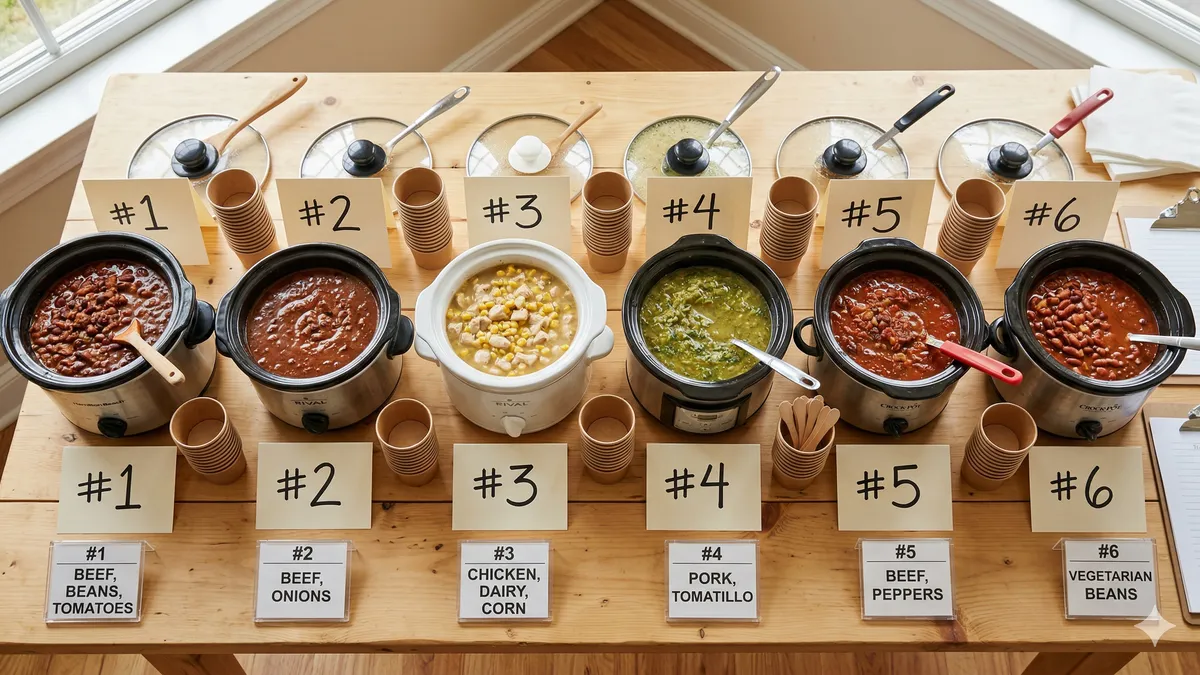
This is the single most important detail. Number every entry and do not reveal who made what until after voting closes. People vote differently when they know their boss made Entry #7. Assign numbers randomly as contestants drop off their entries in the morning.
Line up entries in numerical order on the table. Place the tasting cups in a stack next to each crock pot with a ladle or serving spoon.
Toppings Station
Set up a separate table with toppings. This keeps the main tasting line moving and lets people customize on their own time:
- Shredded cheese
- Sour cream
- Diced onions
- Hot sauce (a few varieties)
- Cornbread or corn muffins
- Tortilla chips
- Sliced jalapenos
Judging and Voting
How you collect and count votes matters more than you'd think.
Judging Criteria
Without a framework, people just vote for "the one I liked best," which tends to reward mild, crowd-pleasing chili over genuinely excellent entries. The five criteria that hold up - flavor, heat, texture, appearance, and aroma - are broken down properly in our chili cook-off judging guide, including how to keep "hottest" from winning by default.
The one office-specific adjustment: keep the criteria list short. Coworkers are tasting between meetings, and a five-criteria rubric across ten entries is fifty judgments. Three criteria is plenty for a lunch-hour event, and you can always run the full rubric the year people ask for it.
Whether to score by allocating points or by rating each entry on a rubric is a real decision with tradeoffs, and it is covered in the points vs rubric scoring guide.
The Paper Ballot Problem
For a small team, paper is fine, and the honest break-even is worked out here. Offices tend to cross it sooner than they expect, because the taster count is the whole floor rather than the entries. Past the threshold, someone always forgets to turn their slip in, two people end up tallying while everyone else stands around, and the energy dies waiting on the math - which in an office means people drift back to their desks before you announce anything.
Cookoff handles QR voting, results the moment you finalize, and winner badges. Setup takes two minutes between meetings.
Set up office cookoff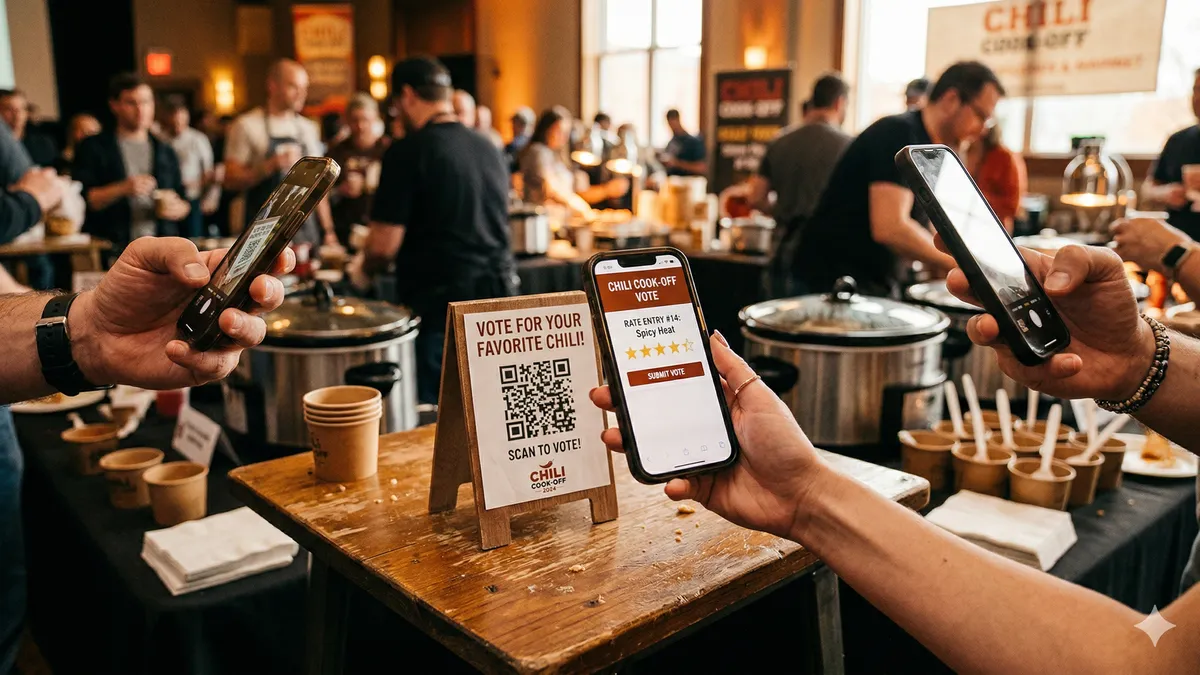
Digital voting solves all of this. Tools like Cookoff let judges score entries from their phones - everyone scans a QR code, rates each chili on your chosen criteria, and results calculate automatically. No ballots to count, ties shown as shared places, no hand counting, and when the last vote's in, you finalize on the spot and reveal the winner with a confetti drop right on the screen. See the full feature list for details on scoring styles and QR code joining.
Whatever method you choose, set a firm voting deadline. "Voting closes at 1:30 p.m." gives people urgency.
Prizes and Recognition
Bragging rights matter more than the dollar value.
Awards
Hand out multiple awards to keep things exciting:
- Best Overall - Highest total score across all criteria
- People's Choice - Most votes when everyone picks one favorite (Favorite voting counts them for you)
- Most Creative - Best use of an unusual ingredient or style
- Hottest Chili - Self-explanatory (consider having a waiver for this one)
- Best Presentation - For the person who went the extra mile with garnishes
Trophy Ideas
A traveling trophy is the office-specific move: the winner keeps it on their desk until next year's cook-off, which makes it visible every day and quietly recruits next year's contestants. A painted golden ladle is the classic. Whatever you pick, make it visible and slightly ridiculous.
For a full range of options, including funny award names and picks at every budget, see our cook-off trophy and prize ideas.
The Best Prize of All
Give the winner the right to pick the theme for the next office cooking competition. Suddenly you've created a tradition and the winner is already invested in organizing the sequel.
Common Mistakes to Avoid
These are the mistakes that trip people up most often:
No vegetarian or dietary options. If all 10 entries are beef chili, you've excluded a chunk of your office. Actively recruit at least one or two vegetarian entries, and mention it in the sign-up email rather than hoping someone volunteers.
Scheduling it against a deadline. Check the team calendar before you pick a date. A cook-off during a release week or month-end close gets a third of the attendance and quietly builds resentment in whoever could not leave their desk.
Letting it become a department event by accident. If the sign-up email only reaches one team, that is who shows up. Send it company-wide and make sure the invite reaches people who work non-standard hours or are remote that day.
No clear timeline. Without a schedule, people graze for two hours and half the office misses voting. Post a simple timeline: 11:30 setup, 12:00 tasting opens, 1:00 voting closes, 1:15 winners announced.
Making the organizer do everything. The person who plans it should not also be buying supplies, setting up, and running the tally. Split it across two or three people or you will not get a volunteer next year.
The mistakes that apply to any chili cook-off - running short on cups and spoons, skipping blind tasting, forgetting allergen labels - are covered in the main chili cook-off guide.
Your Chili Cook-Off Checklist
Print this out and tape it to your monitor two weeks before the event:
2-3 Weeks Before
- Pick a date and book the space
- Send out the rules and sign-up sheet
- Set categories (traditional, white, verde, wildcard)
- Decide on voting method (paper or digital)
- Recruit at least 6 contestants
- Set budget and buy supplies
1 Week Before
- Send reminder to contestants (include allergen label requirement)
- Confirm entry count and buy tasting cups/spoons accordingly
- Buy toppings, sides, and palate cleansers
- Prepare numbered entry cards
- Order or buy prizes/trophies
- Set up digital voting if using an app
Day-Of
- Arrive 30-45 minutes early for setup
- Test all outlets and extension cords
- Assign blind tasting numbers randomly
- Set up toppings station separately from tasting table
- Post the timeline where everyone can see it
- Open voting at the scheduled time
- Close voting on time (no extensions!)
- Announce winners and hand out prizes
- Take a group photo
Start Your Tradition
Keep it simple the first year. Take notes on what worked and what didn't. The best office cook-offs become annual because someone bothered to improve on the last one.
Don't overthink it. People remember the laughs, the friendly trash talk, and the surprising Entry #4 that nobody expected to win. The logistics just have to not get in the way.
Related reading:
- How to Run a Chili Cook-Off: Full 2026 Guide
- How to Judge a Chili Cook-Off: 5 Criteria Judges Actually Use
- How to Win a Chili Cook-Off: Recipe, Spices, and 5 Mistakes
- The Complete Cookoff Judging Guide: Points vs Rubrics
- Ditch the Paper Ballots: Why Cook-Offs Go Digital
- 30+ Cook-Off Trophy & Prize Ideas (Free to $100)
- How to Run a BBQ Cook-Off or Smokeout
Run the office chili cook-off
Cookoff handles QR voting, results the moment you finalize, and winner badges. Setup takes two minutes between meetings.
Set up office cookoff