Ditch the Paper Ballots: Why Cook-Offs Go Digital
Deciding whether to drop index cards? Here is the honest comparison - what paper actually costs you in errors, ties, and dead time, and when it is still fine.
You spent weeks planning the cook-off. The chili is simmering, the brisket is resting, and 30 people are ready to eat. Then voting time rolls around and you're handing out index cards, hunting for pens, and squinting at someone's handwriting trying to figure out if that says "7" or "1."
Paper ballots are the weakest link in any cooking competition. Here's why switching to a digital cookoff voting app fixes the worst parts of running an event - and how to get started without any technical setup.
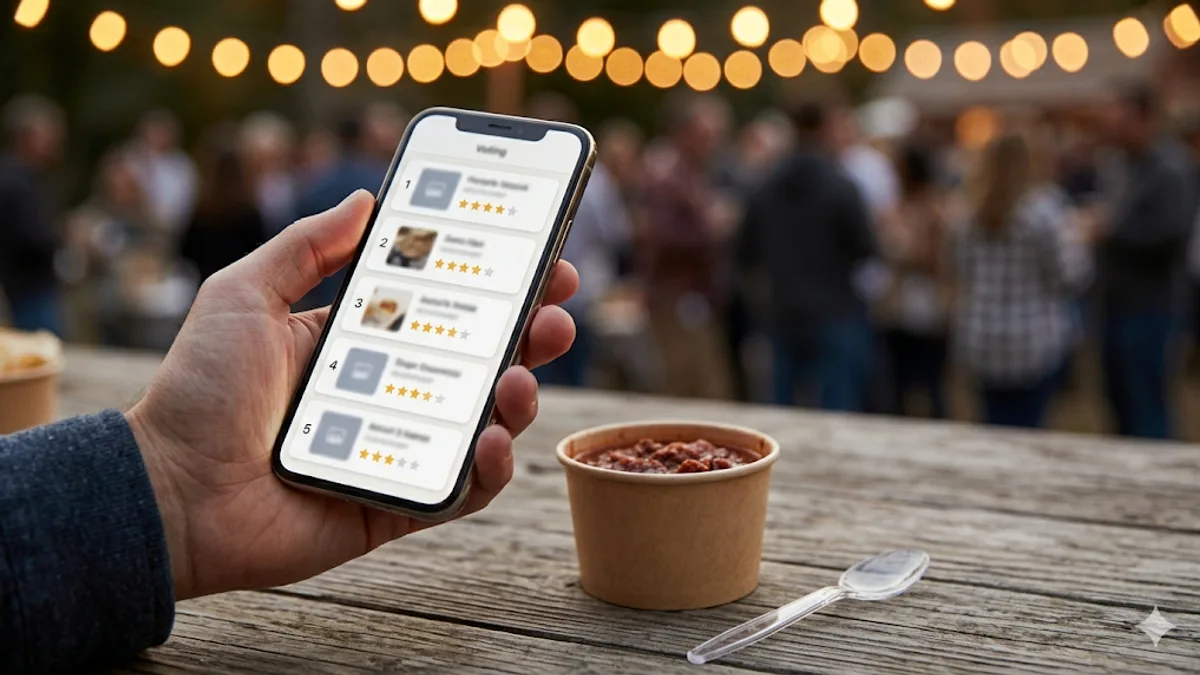
The paper ballot problem
If you've organized even one cook-off, you know the pain. Paper voting sounds simple until you're actually doing it.
Illegible handwriting. Every event has at least one ballot where you genuinely cannot tell what number someone wrote. Was that a 3 or an 8? Did they score the pulled pork or the brisket? When your final rankings hinge on deciphering handwriting, you've got a problem.
Math errors during tallying. Counting votes for a single category is tedious but manageable. Counting votes across four categories with 25 judges and 8 entrees? That's 800 individual scores to add up by hand. One misread digit or calculator typo and your results are wrong. Nobody catches it because nobody wants to recount.
The 30-minute dead zone. Voting ends and everyone stands around while you disappear into a corner with a stack of paper and a calculator. The energy in the room drops. People start leaving. By the time you announce winners, half the crowd has moved on to dessert.
Ties with no plan. Paper systems almost always produce ties, especially in smaller groups. Then what? You flip a coin or call a re-vote, and the rule gets made up on the spot after everyone has seen the scores.
No transparency. When someone questions the results (and someone always does), you can't pull up a breakdown. You've got a pile of index cards and a number on a whiteboard. That's it.
What digital voting actually looks like
It's not complicated. The basic flow works like this:
- Organizer creates an event and adds the list of dishes.
- Judges get a link or scan a QR code - no account creation, no app download required.
- Everyone scores dishes on their phone as they taste.
- Results are calculated instantly when voting closes.
That's it. No paper, no pens, no counting.
Judges submit scores directly into a system that handles all the math. There's no transcription step where errors creep in and no ambiguity about what someone meant.
Points-based vs rubric-based scoring
The two main approaches - points and rubric - serve different types of events.
Points-based scoring
Each judge gets a fixed number of points (say, 5) to distribute across all the dishes. You might give 3 points to your favorite chili, 2 to the runner-up, and nothing to the rest. Or spread them 2-2-1. It's your call, but you can't exceed your total.
This system forces real decisions. When everyone can just give every dish a 5 out of 5, you end up with a meaningless tie. Points-based voting prevents that by making judges prioritize. If you love the brisket, you have to take points away from something else.
Best for: Casual events, office cook-offs, neighborhood potlucks. Simple to understand, fast to vote, and the results feel decisive.
Rubric-based scoring
Each judge scores every dish on multiple criteria - taste, presentation, creativity, texture - on a 1-10 scale. The scores get averaged across criteria and judges to produce final rankings.
This gives much more detailed feedback. An entrant might learn their flavor was top-notch but their presentation needs work. It also smooths out individual bias since the score is an aggregate across several dimensions.
Best for: Serious competitions, charity cook-offs with prizes, events where entrants want real feedback. Takes a bit longer to vote, but the results carry more weight.
Which should you pick?
If people are wearing aprons and having fun, use points. If there's a trophy or prize money on the line, use rubric. Either way, digital handles the math for both - and rubric scoring across 6 criteria and 10 entrees is genuinely painful to do by hand.
The instant-results advantage
With paper ballots, results are a black box until the organizer finishes counting. With digital voting, results calculate the instant you finalize - no manual tallying, no black box. This shift matters more than you'd expect.
It keeps everyone in the loop. Instead of a mystery until the count is done, you can check the admin dashboard at any point to see who's voted and who hasn't, right up until you close the ballot. People stay engaged because they can see the event moving toward a real moment: the reveal.
The organizer stays present. Instead of hunching over a table doing arithmetic for half an hour, you're part of the event. You can see vote progress on your phone and announce results the moment voting closes. No delay, no dead zone.
Results are transparent. Every vote is recorded. If someone questions the outcome, you can pull up the full breakdown - total scores, per-judge distributions, category-by-category results. No more "trust me, I counted right."
Fewer ties. Point distribution pushes judges to differentiate. When two dishes do tie, Cookoff shows them sharing the place. Rubric systems produce averaged decimals (7.3 vs 7.1) that almost never land on the same number. If they do, the per-criteria breakdown shows where each dish was stronger.
Getting started with digital cook-off voting
You've basically got two routes: a tool built for this, or something you rig up yourself. If you'd rather see the landscape first, we compared the free cook-off voting apps side by side - what each one costs, what it does with categories, and where the free tiers stop.
The purpose-built option
Cookoff is a free app (web + iOS) built specifically for cook-off voting. See the features page for the full list. It handles favorite (one pick per person), points, and rubric voting, supports multiple categories (best chili, best side dish, best dessert), and gives you a full results breakdown when voting ends. There's also an iOS app if you want to manage things from your phone.
Setup runs about ten minutes the night before, and the whole thing hangs off one QR code that every judge scans. The step-by-step QR setup walkthrough covers generating the code, what size to print it, and how to test it before the room fills up.
The DIY option
You can also build something with Google Forms. Create a form with a rating scale for each dish, share the link, and export to a spreadsheet when voting ends.
It works, but you won't get automatic results - you'll need to manually close the form and process the spreadsheet. The voting interface isn't great on phones. You'll need to build your own formulas for ranking and tiebreaking. Still better than paper, just more work for the organizer.
Tips regardless of tool
- Print the QR code big. Tape it next to the food table so judges can scan as they taste. A small QR code on a napkin doesn't cut it.
- Number your dishes. Match physical table numbers to the digital entry list so judges know what they're scoring.
- Set a voting window. Give people 20-30 minutes to taste and vote. Open-ended voting means stragglers hold up results.
- Announce results on the spot. The whole point of digital is instant results. Don't wait - read them out while everyone's still together.
When paper is still fine
Digital isn't automatically the right answer. Paper holds up fine when all of these are true:
- Under about 10 judges and under about 5 entries. That's 50 scores. One person can add that up correctly in three minutes.
- One category. The counting problem is multiplicative - it's the second and third category that turns tallying into a chore.
- Nothing on the line. No prize money, no charity total, nobody who will contest the result.
- A crowd that would rather not pull out phones. Some groups genuinely don't want to. A family Thanksgiving pie contest doesn't need a database.
The break-even lands somewhere around 15 judges or a second category, whichever you hit first. Below that, index cards are honestly fine and you should not feel bad about it. Above it, the counting stops being a rounding error and starts being the reason people drift off before you announce a winner.
Bottom line
The point isn't being high-tech. It's getting rid of the worst part of running a cook-off - the counting, the math errors, the 30-minute dead zone, the squinting at handwriting - so you can focus on the food.
Index cards and a calculator got us this far, but they don't have to anymore.
Related reading:
Skip the paper ballots this year
Set up QR-code voting in two minutes. Judges scan, score, done - no app download, no spreadsheet at the end.
Try digital voting