Cook-Off Scoring: Points vs Rubric (When to Use Each in 2026)
Points or rubric scoring? Side-by-side comparison, common criteria for chili and BBQ, fairness tips, and exactly when to pick each method for your cook-off.
You spent weeks planning the cookoff. The chili is simmering, the smokers are running, and twelve people are about to taste six dishes. Then someone asks: "So how do we actually score this?" (If you specifically need a chili cook-off judging breakdown, we have a deeper guide for that too.)
If you don't have a good answer, things go sideways fast. Confused judges, disputed results, and the person who brought store-bought cornbread somehow winning Best Chili. The scoring system shapes everything - how long voting takes, whether the results feel legitimate, and whether anyone wants to do this again next year.
The two main approaches are points-based and rubric-based, plus a simpler third option for crowds: one vote per person. Each works well in different situations, and picking the wrong one is a reliable way to turn a fun afternoon into an argument.
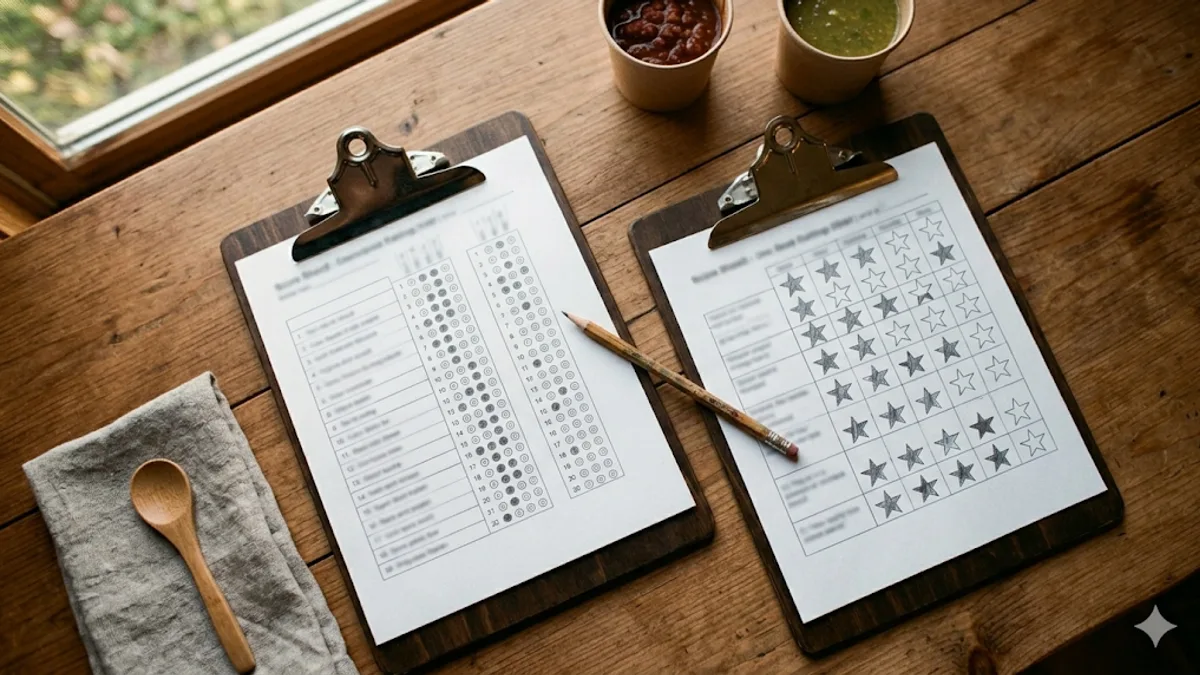
The two chili sanctioning bodies land on opposite sides of this same split - ICS ranks a top three and converts it to points, while CASI collapses everything into one score. What the official chili cook-off rules actually say breaks down both.
Points-Based Scoring: Simple, Fast, Decisive
Each judge gets a fixed pool of points - say, 5 - to distribute across all the dishes however they want. You can't give everyone full marks. You have a limited budget, and you have to make choices.
How It Works in Practice
Say there are four dishes and each judge has 5 points to spend. One judge might score them 3-1-1-0, loading up their favorite. Another might spread it out 2-2-1-0. A third might go all-in with 5-0-0-0. Every distribution is valid as long as the total adds up to 5.
That constraint is what makes it work. Traditional "rate each dish 1-5" scoring tends to produce a sea of 4s and 5s where every dish looks the same. Points force judges to differentiate, so the final rankings actually reflect preferences.
When Points Scoring Shines
Pros:
- Dead simple to explain. "You have 5 points. Spread them across the dishes."
- Voting takes 2-3 minutes per person
- Forces real differentiation between dishes
- Results are easy to tally
- Works with any number of judges
Cons:
- Doesn't tell you why a dish won or lost
- No feedback for the cooks beyond a final ranking
- Less precise when dishes are very close in quality
Best for: Office potlucks, neighborhood cookoffs, casual competitions, events with 4-8 dishes and any number of judges.
Rubric-Based Scoring: Detailed, Transparent, Professional
Instead of distributing a lump sum, judges score each dish on multiple criteria, each on a 1-10 scale. The final score is the average across all criteria. This is how serious competitions work, from local BBQ contests to the World Food Championships.
Common Criteria by Competition Type
The criteria should match what you're cooking. Some battle-tested sets:
Chili Cookoff Scorecard:
- Flavor (depth, balance, seasoning)
- Heat (appropriate level, builds well)
- Texture (consistency, bean/meat ratio)
- Aroma (smell before tasting)
- Appearance (color, garnish, presentation)
BBQ Cookoff Scorecard:
- Flavor (seasoning, sauce balance)
- Tenderness (texture, moisture, pull)
- Smoke (presence, quality, balance)
- Presentation (plating, visual appeal)
Baking Competition Scorecard:
- Taste (flavor, sweetness balance)
- Texture (crumb, moisture, structure)
- Presentation (appearance, decoration)
- Creativity (originality, risk-taking)
General Cookoff Scorecard:
- Taste (overall flavor quality)
- Presentation (visual appeal, plating)
- Creativity (originality, unique ingredients)
- Texture (consistency, mouthfeel)
Three to five criteria is the sweet spot. Fewer than three and you lose the benefit of detailed feedback. More than five and judges get fatigued, especially after tasting multiple dishes.
When Rubric Scoring Shines
Pros:
- Detailed feedback for every cook on every dimension
- Transparent - everyone can see how scores break down
- Professional feel that raises the stakes
- Reveals strengths and weaknesses (great flavor but poor presentation)
- Less susceptible to popularity bias
Cons:
- Takes longer per dish (1-2 minutes of scoring per entry)
- Can feel overwhelming at casual events
- Requires more explanation upfront
- Judges may score inconsistently across criteria
Best for: Competitive events, fundraisers with prizes, when cooks want detailed feedback, events with 2-6 dishes and a smaller panel of judges.
Points vs Rubrics: Side-by-Side Comparison
| Factor | Points-Based | Rubric-Based |
|---|---|---|
| Setup time | 1 minute | 5-10 minutes (define criteria) |
| Voting speed | 2-3 min per judge | 5-10 min per judge |
| Judge skill needed | None | Some (consistent scoring) |
| Feedback for cooks | Ranking only | Per-criterion breakdown |
| Best dish count | 4-8 dishes | 2-6 dishes |
| Best judge count | Any number | 3-12 judges |
| Vibe | Casual, fun | Serious, competitive |
| Dispute risk | Low | Very low |
Keeping It Fair
Regardless of method, a few practices make a big difference in whether results feel legitimate.
Blind Tasting
Number the dishes and don't reveal who made what until after voting closes. People score differently when they know their boss made dish #3. Keep the key secret until results are in.
Tasting Order Bias
The first and last dishes tasted tend to score higher - it's a well-documented cognitive bias. Encourage judges to taste all the dishes before committing to scores. If you're using rubric scoring, many judges do a quick taste of everything first, then go back through to score.
Self-Vote Prevention
If the cook is also a judge, they shouldn't score their own dish. Easy to overlook at casual events where everyone is both cooking and tasting. Set the rule upfront.
Palate Cleansers
Water and plain crackers between tastings genuinely affect scoring quality. Spicy dishes can wreck your palate for everything that follows. Have water, crackers, or plain bread available at every tasting station.
The E.A.T. Method
The World Food Championships uses Execution, Appearance, Taste (E.A.T.) as their framework. Execution covers technique and doneness. Appearance covers presentation and plating. Taste covers flavor, seasoning, and balance. If you're not sure where to start with your rubric criteria, it's a solid default.
One Vote Per Person: The Crowd Option
Sometimes nobody needs a scoring system at all. For a People's Choice award, a festival line, or a crowd that will only taste once, give every person one vote and let them pick the dish they liked best. Most votes wins.
Pros:
- Nothing to explain. "Pick your favorite."
- Voting takes seconds, so it works with hundreds of tasters
- Everyone understands the result
Cons:
- Second favorites count for nothing, so a dish everyone liked a lot can lose to one a few people loved
- Ties are more likely with a small crowd
- No feedback for the cooks beyond the vote count
If you want second favorites to count, ask for a ranked top three instead and score it 3-2-1, the way ICS does for chili.
Best for: People's Choice awards, food-truck festivals, and any crowd voting from a QR code. In Cookoff this is Favorite voting: each person taps one dish per category (or ranks a 1st, 2nd, and 3rd with the "Top 3, ranked" option) and the votes count themselves.
Which Method Should You Use?
Go with one vote per person (Favorite) if:
- The crowd is large or only tasting briefly
- It's a People's Choice award
- You want voting to take seconds, not minutes
Go with points if:
- You have more than 8-10 judges
- The vibe is casual or social
- You want voting to take less than 5 minutes
- You have more than 6 dishes to score
- You don't need per-criterion feedback
Go with rubrics if:
- You have a designated judge panel (3-12 people)
- The event is competitive with real prizes
- Cooks want detailed feedback on their dishes
- You have 2-6 dishes to evaluate
- You want the results to feel bulletproof
Or do both: Have the crowd pick one favorite each for a "People's Choice" award while a smaller judge panel uses rubric scoring for the official winner.
You can also just start with points. See how it goes. Upgrade to rubric next time if people want more structure.
Setting Up Your Cookoff Scorecard
Paper Scorecards
For small events (under 10 judges), paper works fine. Print a grid with dishes as rows and criteria as columns, or just a points allocation section.
The downside is math. With 8 judges and 6 dishes on a rubric with 5 criteria, that's 240 individual scores to tabulate by hand. Errors happen.
Digital Scoring
For anything bigger, a digital tool saves time and prevents math errors. Cookoff supports favorite, points, and rubric voting - set up your event, add the dishes and criteria, share a link, and results tally themselves. See the features page for the full breakdown of all three voting styles.
Whatever you pick, explain the scoring before tasting begins. Answer questions upfront. A confused judge produces bad data, and bad data produces arguments.
Pick your method, keep it fair, and let the best dish win.
Related reading:
Ready to pick your scoring style?
Create a cookoff with the format that fits - points budget for casual events, star scoring for serious judging. Either takes about two minutes to set up.
Create your first cookoff