How to Judge a Bake-Off (Criteria + Score Sheet)
What judges should actually score, how to weight it, and a score sheet you can copy. Plus the criteria that change between cookies, cakes, pies, and bread.
The fastest way to ruin a bake-off is to hand people a slip of paper that says "vote for your favorite."
You get a winner, technically. What you don't get is a result anyone believes. The gorgeous cake wins because it was gorgeous. The pie that tasted better than anything else on the table finishes fourth because it looked like a pie. And the baker who spent two days laminating dough watches a box-mix cupcake with good frosting take the trophy.
Judging is the part of a bake-off people put the least thought into and complain about the most. This is how to do it properly: what to score, how to weight it, and a sheet you can copy.
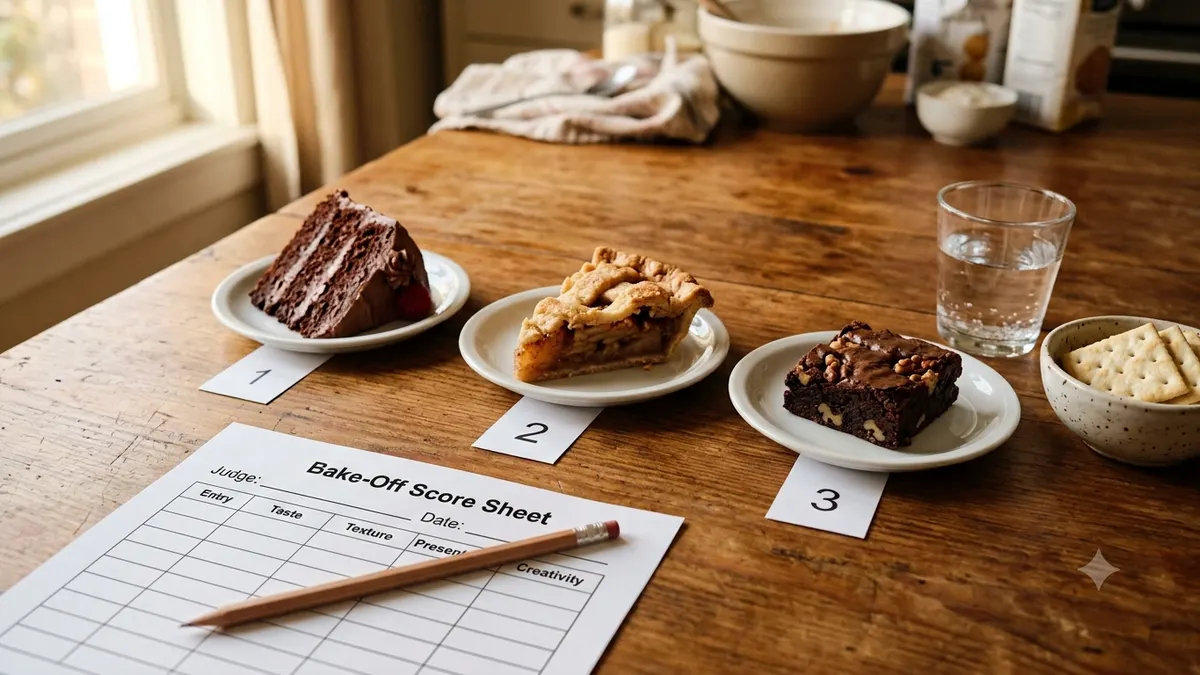
Score four things, not one
Ranking entries against each other ("which is your favorite?") throws away information and hides the reasoning. Scoring each entry against fixed criteria keeps it.
Four criteria cover nearly every bake-off:
Taste - 40%. Flavor balance, depth, whether the sweetness is doing all the work. The question isn't "did I like it" so much as "did this achieve what it was going for." A lemon tart should taste aggressively of lemon. A brown butter cookie should taste of brown butter and not just sugar and salt.
Texture - 25%. This deserves its own line and most homemade score sheets skip it. Texture is where skill actually shows up: crumb on a cake, chew or snap on a cookie, lamination on a pastry, whether a pie base is crisp or has gone to sog. Two bakers can hit the same flavor and be a mile apart here. Fold texture into taste and you lose the single most diagnostic thing on the sheet.
Presentation - 20%. How it looks, and whether the look was intentional. Enough weight that effort counts, not enough that decoration beats baking. Twenty percent is deliberate - high enough to reward someone who piped every rosette, capped low enough that it can't outrun a 40% taste score.
Creativity - 15%. Did they try something? An unusual pairing, a technique with real risk in it, a familiar thing executed unusually well. Keep this last and keep it small, or you end up rewarding novelty over competence - the lavender-cardamom experiment that nobody wants a second bite of.
Score each 1-10 and apply the weights at the end. Do not ask judges to do weighted arithmetic while they taste; they will get it wrong and they will resent you.
The criteria shift by category
This is the part generic advice misses. "Texture" doesn't mean the same thing across a dessert table, which is why judging a sourdough against a decorated sugar cookie produces nonsense no matter how good your sheet is.
| Category | What texture means here | Presentation weight | Watch for |
|---|---|---|---|
| Cookies & bars | Chew, snap, spread, whether the edge and center differ on purpose | Lower - a cookie is a cookie | Overbaking; identical dough with different mix-ins |
| Cakes & cupcakes | Crumb tightness, moisture, whether frosting overwhelms | Higher - decoration is half the craft | Dry crumb hidden under heavy frosting |
| Pies & tarts | Bottom crust above all; filling set, not weeping | Lower - rustic is legitimate | Soggy base; a filling that slumps once cut |
| Breads & pastry | Crumb structure, crust, lamination, rise | Lowest - looks follow function | Dense crumb; underproofed and gummy |
| Wildcard | Judge against what it was trying to be | Middle | Comparing it to anything else |
If you have eight or more entries, split into categories and judge inside each. If you have fewer and categories would feel silly, at least brief your judges out loud: score each entry against what it was trying to be, not against the entry before it.
A score sheet you can copy
One row per entry, one column per criterion. Entry numbers printed in advance so nobody writes a name.
| Entry # | Taste (1-10) | Texture (1-10) | Presentation (1-10) | Creativity (1-10) | Comments |
|---|---|---|---|---|---|
| 1 | |||||
| 2 | |||||
| 3 | |||||
| 4 | |||||
| 5 | |||||
| 6 |
Weighted total = (Taste × 0.4) + (Texture × 0.25) + (Presentation × 0.2) + (Creativity × 0.15)
Two things about this sheet that matter more than the layout:
Keep the comments column. It's the part bakers actually want. Scores tell someone they came fourth; a line saying "filling was excellent, base needed another ten minutes" is the thing they'll fix next year. Make it a soft requirement - one sentence per entry, minimum.
Print the entry numbers. A blank number column is an invitation to write "Dana's carrot cake," and once one sheet has a name on it your blind tasting is decorative.
Need sheets for a different format? Our cook-off score sheet templates cover points and rubric layouts for chili, BBQ, and general competitions.
Rules that prevent the arguments
Most bake-off disputes trace back to something nobody wrote down. These are the rules worth stating in the sign-up email, not discovering on the day:
- Homemade only. Say it explicitly. Somebody will otherwise bring a bakery cake and genuinely not think it was against the rules.
- One entry per baker, unless you're running categories and want to allow one per category. Decide before, not when someone shows up with three.
- Allergen labels are mandatory. Collect them on the sign-up form rather than scribbled on a card at drop-off, so bakers declare while the recipe is still in front of them and you are not chasing anyone at the door.
- A drop-off cut-off time. Entries arrive by 11:30, judging starts at noon. Late entries are welcome to be eaten and not scored - sounds harsh, works fine, and it only takes one late entry disrupting a flight for you to adopt this permanently.
- Pre-cut or bring something to cut with. Everyone hesitates to be the first to slice a whole cake. Pre-portioning removes the hesitation and makes sure the twelfth judge gets the same experience as the first.
- Judges don't score their own entry. If your panel is also competing, have them abstain on their own row rather than scoring it honestly-but-generously.
- Scores are final once revealed. Publish this. It ends the re-count conversation before it starts.
For the wider event rules - sign-ups, categories, timeline - the cook-off rules template is a copy-paste starting point.
Panel or crowd?
Both work. They answer different questions.
A panel of 3-5 tastes every entry in a controlled order with cleansers between. Slower, more defensible, and the right call whenever there's real prize money or a charity total attached. Odd numbers are conventional but matter less than you'd think once you're averaging weighted decimals rather than counting votes.
Crowd voting is more fun and far more inclusive, and it has one real flaw: almost nobody tastes everything. What you get is partly a measurement of who set up nearest the door. That's fine for a friendly event - just don't present it as a rigorous outcome.
The common answer is to run both: the panel picks Best Overall, the room picks People's Choice, and two people go home happy instead of one. If you want the longer comparison of scoring mechanics, the points vs rubric guide covers when each one is appropriate.
Palate fatigue is the thing that quietly breaks your results
Our own event started as a chili cook-off and drifted over the years into pie and dessert competitions, and the difference in how fast judges burn out is not subtle. You can work through a dozen chilis. You cannot work through a dozen desserts.
Sugar and fat coat your palate. Somewhere around the eighth or ninth rich entry, judges stop distinguishing between good and very good, and everything after that gets marked down for the crime of being served late. That's a scoring artifact, not a quality signal, and it can absolutely change your winner.
Worth being precise about what to cap, because this trips people up: a flight is how many entries a judge tastes in one unbroken sitting. That's a different number from how many entries your event accepts. A 14-entry bake-off is completely fine - split across two categories, it's two flights of seven, and no palate ever sees more than seven.
Three fixes, in order of how much they help:
- Cap a flight at 8-10 entries. More than that, split into categories or rounds with a real break between. The hosting guide's 6-12 range is about total entries for a single-category event, which lands inside this anyway.
- Randomize the tasting order per judge. If judge one starts at entry 1 and judge two starts at entry 7, the fatigue penalty spreads out instead of always landing on the same entries. This costs nothing and is the single most effective thing on this list.
- Water and unsalted crackers, within arm's reach. Not lemonade, not coffee. Something without a flavor of its own.
Small portions help too. Judges need two forkfuls, not a slice.
Mistakes that produce the wrong winner
Scoring on a single "overall" number. You lose all the diagnostic information and the prettiest entry wins by default.
Letting judges see the entries before scoring starts. They form opinions during setup and spend the tasting confirming them.
Announcing running scores mid-judging. Judges anchor to each other. Collect independently, reveal at the end.
No comments. The scores get forgotten by the drive home; the feedback is what makes people enter again next year.
Not weighting. Four equal criteria makes creativity worth exactly as much as taste, which is how a beautiful, interesting, mediocre-tasting cake wins.
Tallying by hand with more than about ten judges. Ten judges scoring eight entries across four criteria is 320 numbers, each needing a weight applied before anything gets averaged. We ran ours on paper for five years, and the tallying is most of the reason this app exists - voters scan a QR code, score from their phones, and the weighting happens automatically.
The short version
Score taste, texture, presentation, and creativity at 40/25/20/15. Judge inside categories - bread and cake are not the same problem, and pretending otherwise is how you get a nonsense winner.
Keep a flight to 8-10 entries. Randomize who starts where. Put water on the table.
Then the small stuff that turns out not to be small: print the entry numbers yourself, insist on one line of written feedback per entry, and don't unseal the names until the scores are locked.
Do that and the result holds up - including to whoever came second.
Related reading:
- How to Run a Bake-Off Competition: 2026 Guide + Judging Rubric
- Cook-Off Score Sheets: Free Templates + Digital Alternative
- The Complete Cookoff Judging Guide: Points vs Rubrics
- Cook-Off Rules Template You Can Copy and Paste
- How to Host a Holiday Cookie Exchange Contest (Rules + Judging)
- How to Judge a Chili Cook-Off (Criteria, Process, and Common Pitfalls)
Let the scorecard do the math
Cookoff runs the rubric for you - judges score each entry from their phones and the weights apply automatically. The winner is ready the moment the last sheet is in.
Score my bake-off