How to Host a Soup Cook-Off: Categories, Rules & Scoring (2026)
Host a soup cook-off that nails the cold-weather sweet spot. Categories, batch sizes, serving cup logistics, judging criteria, and the digital scoring setup.
Soup is the most underrated cook-off food. It travels in a slow cooker, holds warm for hours, scales easily, and the variety inside the category is enormous - chicken noodle, ramen, gazpacho, butternut bisque, tortilla soup, gumbo, and miso can all show up at the same event. If you want a low-effort cook-off that works in cold weather, this is the one.
This guide covers everything you need to host one: categories, rules, equipment, judging, and the digital scoring setup that makes tallying winners painless.
Why Soup Beats Most Other Cook-Off Foods
A few things make soup uniquely well-suited to competition.
It's forgiving. Soup is hard to mess up beyond fixing. Over-seasoned? Add stock. Under-seasoned? Add salt. Too thick? Thin it. The quality floor is high, which keeps casual cooks from dropping out.
Tasting portions are tiny. A 2 oz cup is enough to judge a soup. That means even an event with 12 entries doesn't fill anyone up - by entry five at a chili cook-off you're done, but by entry five at a soup cook-off you're just warming up.
Slow cookers handle the logistics. Every cook brings their own crock pot, plugs it in, and the soup stays at serving temperature for the entire event. No reheating, no chafing dishes, no last-minute station setup.
Dietary diversity is automatic. Vegetarian, vegan, dairy-free, and gluten-free options come naturally to the soup category. You don't need to actively recruit "the vegetarian entry" - half the lineup ends up being plant-friendly without trying.
It's a cold-weather event. The peak season runs October through February. If you've ever tried to plan a cook-off and felt like there's no good time, soup gives you a six-month window where it's actually the right idea.
Choosing Your Categories
The right category count depends on how many cooks are competing.
Small Event (4-8 Cooks)
One open category works fine. Let everyone enter whatever soup they want and judge on a single best-overall rubric. Too many categories at this scale just thins out the competition.
Medium Event (8-15 Cooks)
Three categories balance variety against judge fatigue:
- Brothy - Chicken noodle, minestrone, pho, ramen, French onion, chicken and rice, wedding soup. Anything where the broth is the star.
- Creamy / Chowder - Clam chowder, broccoli cheddar, butternut bisque, potato leek, tomato bisque, corn chowder, beer cheese. Texture-forward entries.
- Vegetarian / Vegan - Lentil, miso, mushroom, tomato basil, gazpacho, ribollita, tortilla soup (vegetarian version). Separating this category means plant-based cooks aren't competing against an oxtail stew.
Large Event (15+ Cooks)
Five categories keep things manageable without becoming a bracket:
- Brothy
- Creamy / Chowder
- Vegetarian / Vegan
- International - Tom yum, borscht, harira, posole, dashi-based, hot and sour, kimchi jjigae. Forces a broader regional lens.
- Cold soup wildcard - Gazpacho, vichyssoise, cucumber yogurt, watermelon. Niche but a fun palate change halfway through tasting.
The cold soup category is a novelty, but in late spring or early fall it's a legitimate genre and a refreshing reset between heavier entries.
Rules That Actually Matter
Send a one-page rules doc a week before the event. Most disputes at any cook-off come from unclear rules, not tough judging calls.
Cover these:
- Batch size - Minimum 1.5-2 quarts. This is the most important rule. A 6-quart slow cooker holds plenty for a 30-person tasting and leaves a small reserve for spillage and seconds.
- Vessel - Slow cooker or other heated vessel only. No room-temperature delivery, no ice baths to keep cold soups cold (those go on ice in the morning).
- Allergens - Required label on every entry: name of the soup plus common allergens (dairy, gluten, shellfish, nuts, soy). Print on a 4x6 index card and tape it to the slow cooker.
- Garnish policy - Either each cook supplies their own garnishes (croutons, sour cream, scallions, oil drizzle) OR set up a shared garnish bar. Don't let some entries arrive fully dressed while others sit plain.
- Homemade only - No store-bought, no canned, no restaurant takeout. Spell it out.
- Arrival window - Set a firm drop-off time (e.g., 11:30 a.m. for a noon tasting). Late entries skip the blind-tasting number assignment and get tasted last.
Equipment and Setup
Soup is low-tech compared to BBQ, but the tasting line still needs a few essentials.
The Tasting Line
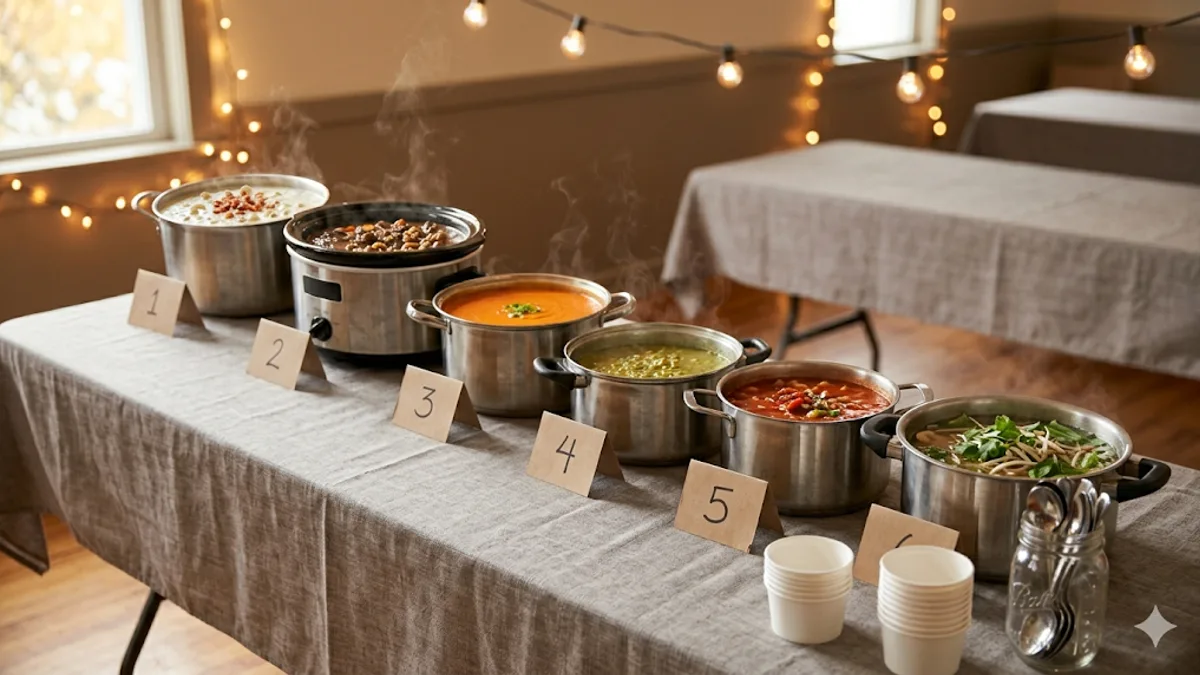
Set up numbered slow cookers in a row down a long table. Each station gets:
- A printed number card (1, 2, 3, ...) propped against the slow cooker
- A small allergen card next to the number
- A stack of 2 oz portion cups (the kind used for restaurant condiments work perfectly)
- Disposable spoons in a cup or jar
- A ladle resting in the soup
Put the soups in a deliberate order: lighter and brothy first, heavier and creamier later. Cold soups come last unless you've made them their own category. This prevents palate fatigue from clobbering the subtle entries.
Palate Cleansers
Soup tasting fatigue is real after entry six or seven. Keep these nearby:
- Water (a lot of it - one gallon per 8 tasters)
- Plain saltines or oyster crackers (no flavored variants)
- Plain bread or baguette slices
- Cucumber slices for richer, creamier flights
Toppings Bar (Optional)
A separate small table with shared toppings keeps the main line moving and lets tasters customize:
- Croutons or oyster crackers
- Sour cream and chopped scallions
- Hot sauce (a few options)
- Olive oil and chili crisp
- Lemon and lime wedges
- Fresh herbs (parsley, cilantro)
Judging Criteria
Soup rewards balance more than any single flashy ingredient. Score each entry on these four criteria, 1-10:
- Flavor - Does it taste fully developed? Does the broth have depth? Are the spices and aromatics doing real work?
- Body and texture - Right consistency for the style? Creamy soups creamy without being gluey? Brothy soups balanced with the right amount of solids?
- Seasoning balance - Salt, acid, heat, and umami in the right proportions? A perfectly seasoned soup tastes finished, not flat.
- Creativity or authenticity - For traditional entries, does it honor the tradition? For creative entries, does the twist actually work?
Score all four and average them - by default each counts equally. A great soup is a fundamentals exercise, so if you want flavor to matter more, give it more weight: Flavor 40%, with Body/texture, Seasoning balance, and Creativity/authenticity splitting the other 60%. Cookoff does the weighted math automatically.
For a deeper breakdown of why this scoring framework holds up across formats, see the cook-off judging guide.
Judges vs. People's Choice
Three to five judges is the right panel size. More than five and scheduling becomes a chore; fewer than three and a single odd opinion can decide the winner.
Look for people who care about food but aren't competing - the local bakery owner, a chef friend, the coworker who always brings the best leftovers, or someone who runs the foodie corner of your office Slack.
If you want everyone to participate, run a People's Choice award alongside the judge panel. After the judges finish their pass, open the line to spectators with one vote each. A QR code that opens a Favorite voting ballot does the counting for you: everyone taps the soup they liked best. Tally separately and announce both winners.
Digital Scoring Makes This Easy
Adding up rubric scores by hand across five judges, four criteria, and three categories is the fastest way to push your event from "wraps at 1:30 p.m." to "wraps at 4." Digital ballots eliminate the math. Cookoff gives every judge a phone-based scorecard that averages every score automatically and produces winners by category the moment the last vote lands.
For the People's Choice side, a QR code posted at the tasting line lets every taster vote in seconds. See the features page for how rubric scoring, points voting, and automatic results stack together in a single event. If you're new to phone-based voting, the QR code voting setup guide walks through the configuration.
Shopping Checklist
For an 8-cook, 30-taster soup cook-off:
- Tasting cups - 2 oz portion cups, ~12 per taster (about 360 cups for 30 tasters across 8 entries)
- Disposable spoons - One per cup, plus 25% extra
- Bowls - Optional for second helpings
- Crackers - 3 sleeves of saltines or 2 boxes of oyster crackers
- Water - 4 gallons for 30 people across 2-3 hours
- Bread - 2 baguettes
- Garnish bar - 1 lb croutons, 1 pint sour cream, 1 bunch scallions, 2-3 hot sauces, fresh herbs
- Allergen cards - Printed 4x6 cards with name and allergen fields
- Number cards - Printed 1-12 stand cards
- Score sheets or digital ballots - Set up in advance, not at the event
- Prizes - See trophy and prize ideas
Total budget: $50-$90 depending on whether the host or contestants cover toppings and crackers.
Common Mistakes to Avoid
Mixing categories on one scorecard. Don't rank a creamy chowder against a vegetable broth. They're different foods judged on different priorities. Keep categories separate.
Tasting cups too big. A 4 oz cup feels generous but it's twice what's needed and judges fill up by entry six. 2 oz is the sweet spot.
No garnish policy. A loaded chowder with sour cream, scallions, and crispy bacon beats a bare chicken noodle on visual appeal alone. Either standardize or supply a shared garnish bar.
Wrong tasting order. Heavy and creamy first means lighter entries taste flat by the time they're tasted. Always go light to heavy, with cold soups last.
Skipping allergen labels. Cream-based soups can hide dairy. Asian soups can hide soy or shellfish. Make labels mandatory and check every entry on arrival.
Not enough crackers and water. Underestimate by half and you're scrambling 45 minutes in. One sleeve of saltines and a gallon of water per 10 tasters is the floor.
No timeline. "Tasting starts at noon, voting closes at 1:15, winners at 1:30" gives the event structure. Without a timeline, voting drags and energy drains.
Your Soup Cook-Off Checklist
1-2 weeks before
- Pick a date and book the space
- Send rules and sign-up sheet
- Set categories
- Decide on judging method (panel, People's Choice, or both)
- Recruit 6-15 cooks
1 week before
- Send reminder with allergen labeling requirement
- Confirm entry count and order tasting cups, spoons, crackers
- Print allergen and number cards
- Set up digital voting if using a phone-based ballot
- Order or buy prizes
Day-of
- Arrive 30 minutes early to set up the tasting line
- Test outlets and extension cords
- Assign blind tasting numbers as cooks drop off entries
- Set up the toppings bar separately from the soups
- Post the timeline visibly
- Open tasting on time
- Close voting on time (no extensions)
- Announce winners and hand out prizes
- Photograph each winning soup for next year's promo
Make It a Tradition
The first soup cook-off is the hardest. The second one runs itself because half the work is already done - the rules doc, the supply list, the judging rubric, and the contestant list all carry forward.
Keep notes on what worked. The best soup cook-offs become annual because someone bothered to improve on the last one - one more category, a better palate cleanser, a tighter timeline, a sharper rubric.
Related reading:
- Cook-Off Judging Guide: Points vs Rubric Scoring
- How to Set Up QR Code Voting for Your Cook-Off
- Cook-Off Score Sheets: Free Templates + Digital Alternative
- 27 Cook-Off Theme Ideas That Actually Work
- Cook-Off Trophy and Prize Ideas That People Actually Want
- How to Host a Potluck Competition
- How to Run a Chili Cook-Off (Full 2026 Guide)
Host the soup cook-off
Cookoff handles judging on flavor, body, presentation, or any criteria you set. QR voting from any phone.
Set up your soup cook-off