What the Official Chili Cook-Off Rules Actually Say
CASI and ICS judge chili with two totally different systems, and the popular '1-10 five criteria' scorecard online matches neither. Here's what each says.
Search "official chili cook-off scorecard" and you'll find the same sheet copy-pasted across dozens of sites: five criteria, aroma, appearance, taste, texture, aftertaste, each scored 1 to 10, add them up out of 50 for a final ranking. It looks official. It has the right vocabulary. It is not what either of the two organizations that actually sanction chili competitions in the United States does.
Chili Appreciation Society International (CASI) and the International Chili Society (ICS) are the two bodies serious chili cook-offs answer to, and they don't just use different numbers - they use fundamentally different kinds of scoring. One collapses everything into a single whole number per cup. The other doesn't use numbers at all. Understanding the real difference matters if you're citing "official rules" to your office or your neighborhood, and it matters even more if you're deciding how to actually run your own event, because the honest answer is that neither rulebook was written for you.
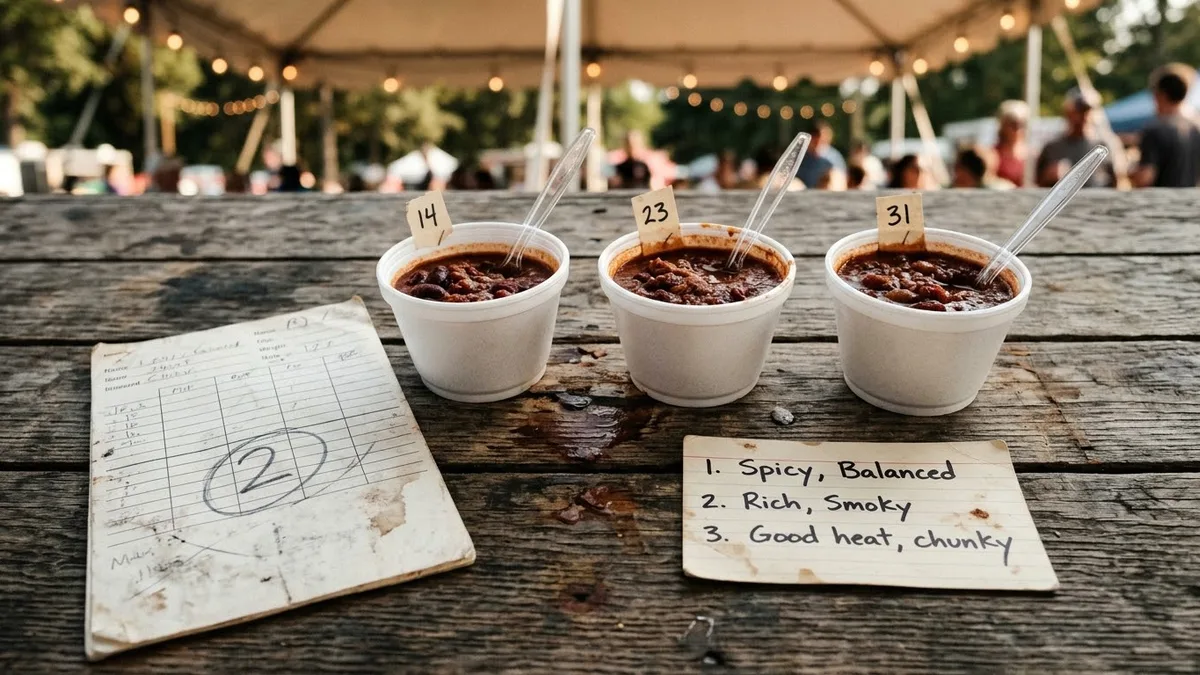
CASI: one number, five things it's judging
CASI's official judging sheet is Form 004, and its rule is more restrictive than most people expect. A judge tastes the chili and weighs five things - aroma, red color, consistency, taste, and aftertaste - but doesn't write down five scores. Those five criteria fold into one whole number from 1 to 10 for the cup, 10 being the best. No pluses, no minuses, no half-points. Just one number that represents the judge's overall impression after considering all five.
Two more rules define the CASI experience:
- You get one shot. Once a cup has been passed to the next judge, it cannot be re-tasted. There's no going back for a second opinion.
- A new spoon every time, and a mandatory palate cleanser between cups - crackers, cheese, or something similarly neutral. CASI's rules even ban tinted eyewear at the judging table, on the theory that a judge shouldn't be influenced by how the chili looks through a tint.
The scores from every judge on every level (CASI runs judging in tiers - preliminary, sometimes intermediate, then a final table) get totaled and ranked in reverse order, tenth place up to first. It's a single-score system run at scale, not a rubric.
ICS: no numbers, just rank
The International Chili Society throws out the scorecard entirely. A judge tastes a flight of chili and does one thing: picks a personal first, second, and third place. That's it. No 1-10, no criteria list, nothing written on a form beyond three rankings.
Behind the scenes, a Chief Scorekeeper turns those rankings into points: three points for every first-place vote a chili gets, two for every second, one for every third. Add up the points across all the judges at a table and the chili with the most points wins the category. The judges themselves never see or produce a number - the points system exists purely for tabulation.
ICS also runs fixed categories, and this is where the two organizations diverge even further. Every ICS cook-off recognizes:
- Traditional Red - meat with red chili peppers, no beans or fillers
- Homestyle - beans required, and visible in every spoonful
- Chili Verde - built on green chili peppers
- Veggie - no meat or meat byproducts at all
- Youth - cooks age 6 to 17, judged separately
- People's Choice - and this one isn't optional. Every adult contestant, in every category, must also prepare and serve a batch of People's Choice chili to the public. It exists specifically as a fundraising mechanism; ICS cook-offs are built to raise money for a charity or nonprofit, and People's Choice is how attendees get to taste and vote with their wallets.
So an ICS event isn't judging "chili" as one thing - it's running four or five separate rank-based competitions in parallel, plus a public vote that every single cook is required to participate in.
The scorecard everywhere online matches neither one
Here's the correction this whole post exists to make. The "official" scorecard that gets reposted across chili sites - five criteria, each scored 1-10, summed for a total out of 50 - isn't CASI's system (which collapses those same five ideas into one number) and isn't ICS's system (which doesn't use numbers at all). It's a hybrid that nobody's actual rulebook describes. It probably started as someone's reasonable-sounding guess at what "five criteria, scored out of 10" ought to mean, and it's been copied enough times that it now reads as gospel.
That doesn't make it a bad scorecard. Scoring five things on a 1-10 scale and adding them up is a perfectly workable way to judge chili - it's just not what either sanctioning body calls official. If you want a rubric like that, Cookoff's chili judging guide walks through five criteria - scored equally by default, or weighted if one should count for more - built for exactly this kind of event. Just don't call it CASI's or ICS's rules, because neither one would recognize it.
Neither system is really about the score anyway
Step back and the real contrast isn't the math - it's the philosophy underneath it. CASI wants a judge to render one considered verdict per cup, informed by everything they noticed but collapsed to a single number, because a rubric total can hide the fact that a chili was mediocre on four things and brilliant on one. ICS wants judges to compare entries directly against each other in a single sitting, because ranking three entries out of a flight of ten is often a more honest task for a human palate than assigning an absolute number to each one in isolation.
That's the same tension behind points-based versus rubric-based scoring in general. ICS's ranked top-three is a points system - a scarce resource (first, second, third) spent across entries, forcing real differentiation. CASI's single 1-10 score per cup is a rubric system, just one with a single, holistic criterion instead of several. The two chili authorities didn't converge on one right answer. They picked opposite ends of the same tradeoff, and both have been running national championships on it for decades.
What neither rulebook is built for
It's worth being honest about who these rules actually serve, because it isn't a backyard host. To even get CASI sanctioning, a cook-off needs a minimum of 15 cups of chili turned in by cooks who were present and cooking, has to be open to at least 50 cooks, and needs a CASI referee physically on site to sign the results sheet. ICS requires every adult cook to be a paid, active ICS member, assigns official 32-ounce competition cups, mandates propane-only cooking in designated 10x10 spaces (no charcoal, no open flame), and has a Chief Scorekeeper role that exists nowhere in a casual event.
Neither organization even makes its rules easy to find. Both publish as PDF only, no crawlable rules page, and ICS in particular tends to reissue a new file under a new name most seasons, so there's no stable URL to bookmark or link to. That's a strong hint about who these documents are written for: chili cook-off veterans working through a sanctioning body's registration packet, not someone printing a scorecard for twelve coworkers on a Friday.
What to actually borrow if you're not sanctioned
None of that means the official rules are useless to you. A few pieces translate cleanly to any casual event, sanctioned or not:
- CASI's no-retaste rule is worth adopting even at a backyard scale. It forces judges to commit to a first impression instead of second-guessing themselves into indecision, and it keeps a tasting moving.
- CASI's mandatory palate cleansers and new spoon per cup are just good hygiene and good judging, full stop, and cost nothing to copy.
- The idea of a People's Choice award running alongside the "real" judging is one of ICS's best ideas for a casual event specifically, because it gives everyone who isn't on the judging panel something to participate in.
- Pick a philosophy, then match your tool to it. If you like CASI's single-verdict approach, use a 1-10 rubric. If you like ICS's comparative ranking, use a points system where judges allocate a limited budget across entries, or Cookoff's Favorite voting with the "Top 3, ranked" option, which scores each voter's 1st, 2nd, and 3rd as 3-2-1, the way ICS tabulates. What you shouldn't do is borrow vocabulary from both and call the result "official," because that's exactly how the mismatched scorecard spread across the internet in the first place.
What you don't need: a $25-per-person membership, a referee on site, a 32-ounce competition cup, or a Chief Scorekeeper. Those exist to standardize hundreds of qualifying cook-offs against each other so a Traditional Red in Texas can be compared fairly to one in Ohio. A single Saturday afternoon with your coworkers or your neighbors doesn't need that kind of standardization - it needs a system your tasters can understand in one sentence and a way to tally it without a spreadsheet.
The bottom line
CASI and ICS aren't two flavors of the same rulebook. One turns five criteria into a single score; the other turns tasting into ranking and never touches a number. The widely shared "five criteria, scored out of 10, added together" scorecard borrows vocabulary from both and rules from neither - it's not wrong to use, just wrong to call official.
For your own event, the real decision isn't which sanctioning body to imitate. It's whether you want a single-score verdict per entry or a ranked, comparative one - and Cookoff runs both, so you can borrow the philosophy that fits your crowd without touching a membership form.
Related reading:
Skip the paperwork, keep the fairness
Cookoff gives you ranked points voting like ICS or a 1-10 scorecard like CASI, whichever fits your event, without a sanctioning packet or a stack of printed forms.
Score my chili cook-off